Methodologies
CX/UX Research & Strategy
Good UX design starts with the user, not the interface. Before any screen gets designed, the real work is understanding who you're designing for: what they need, what's getting in their way, what actually drives their decisions, and how the business can meet that need while staying differentiated and competitive.
This is where CX and UX Strategy earn their place. They're what makes an organisation customer-centric rather than just customer-aware, continuously looping the business's commercial model back into real customer needs, attitudes, values and behaviours, rather than assuming them.
Because what we're all actually after -valuable, accessible, engaging experiences- doesn't come from a tool. It comes from communication, collaboration, and a genuine understanding of the people on the other end.
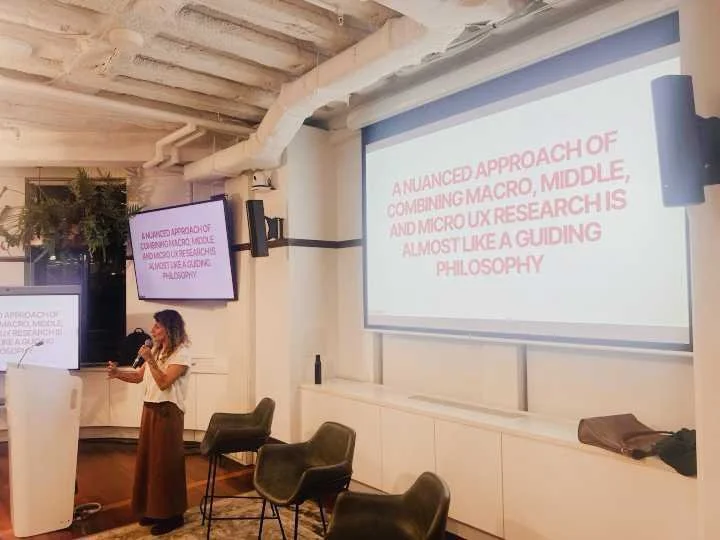
From my talk “Show the strategic value: Bring the ROI to your UX research” | CCX event - Sydney
Here's how that plays out in my process.
Three phases, each grounded in real methods, with collaboration and accountability at the centre of every one of them.
-
Every project starts with the full picture, not a methodology. I kick off with the team to understand their KPIs, business objectives and what's already on the roadmap, then talk to stakeholders across other teams to get their side of the story. From there, I run a light UX audit to build early hypotheses, and pair with the data team to find where the real signals of failure are, Miro, Google Analytics, and Contentsquare usually live in this stage. Only once I have that full picture do I choose the right method: user interviews, usability testing, focus groups, card sorting, tree testing, surveys or concept testing, moderated or unmoderated, depending on what the problem actually needs.
-
I don't call this "data analysis"; that undersells it. This is where I cross-reference what I'm hearing, seeing and measuring to understand who I'm actually designing for. My bread and butter is hybrid moderated testing - interviews combined with moderated usability testing - using Dovetail as my central hub, alongside Optimal Workshop, Askable and UserTesting, depending on the method and the company. I do the analysis myself: rewatching sessions, reading transcripts, and finding and digesting the patterns by hand, because that judgment is the actual job. AI comes in afterwards, purely to help format what I've already found, it doesn't do the thinking, I do. In my view, the tool matters far less than the person using it. Tools are quick to learn; the judgment to make them useful takes years. Thirteen or fourteen years ago none of this software existed, and the work still got done.
-
Insight only matters if it turns into something real. I move from insight to solution through a prioritisation session with engineering, data and design together, weighing effort, business goals and user needs, sometimes with a formal framework like RICE or a value matrix, sometimes with informed judgment. From there, everyone gets a seat in ideation and wireframing, design, data, and engineering all included, regardless of who usually touches design work. We mix and match the strongest ideas into a direction, then I take that into wireframes and Figma prototypes, low-fidelity first where the problem is still being validated, higher-fidelity once we know what we're testing, before putting it in front of real users.
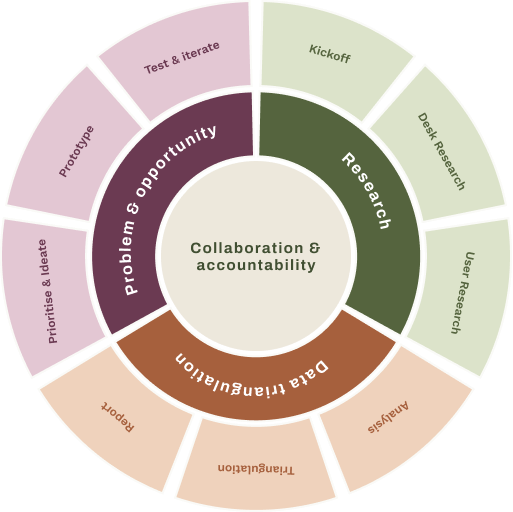
Collaboration & Accountability
Cross-functionality isn't a workshop you run once, it's everyone contributing their knowledge and expertise from the very start, building a shared understanding of the problem together, rather than passing insight down a line one team at a time.
But collaboration alone isn't enough. I believe researchers are accountable for what happens after the insight, not just for generating it. Did it lead to a new feature? Did it push engineering toward a better solution? Did it move the numbers that mattered? Generating insight is the easy part. Being responsible for what's done with it is the job.
Let’s Chat
I'd love to hear from you and talk about how I can help.